


THE
TRUTH IS...
Despite advancements in Hemophilia A therapies, bleeds are still happening1,2


Luke lives with hemophilia A.
In a real-world study of patients with moderate-to-severe hemophilia A, the percentage of patients who experienced ≥1 bleed in first year of treatment1:

ON FVIII MIMETICa

ON SHL PROPHYLAXISa

ON EHL PROPHYLAXISa
aAmong participants with ≥6 months of treatment exposure during Year 1, ABR was calculated based on bleed events data only.
ABR=annualized bleeding rate; EHL=extended half-life; FVIII=Factor VIII; SHL=standard half-life.
Healthcare providers may refer to individual product labels for product-specific efficacy and other information. Data are descriptive, not head-to-head.
Descriptive, observational cohort study in which eligible participants, including children and adults residing in the United States who were diagnosed with moderate to severe hemophilia A, were enrolled in the PicnicHealth database on or before October 3, 2022. Three cohorts were established to evaluate (1) treatment patterns between 2019 and 2022; (2) clinical outcomes by prophylactic therapy class (SHL FVIII; EHL FVIII; FVIII mimetic); and (3) health-related quality of life (HRQoL) using the Patient-Reported Outcomes Measuring Instruments System (PROMIS)-29 survey and a supplemental pain survey. Patients switching treatment classes were included in multiple treatment groups. In the “clinical outcomes population,” 88 used EHL FVIII prophylaxis, 141 used SHL FVIII prophylaxis, and 82 used FVIII mimetic prophylaxis. Because patients who switched treatment classes were included in multiple treatment groups, cohorts were not mutually exclusive. As a retrospective medical record study, missing or incomplete documentation may have led to underestimation of treatment use, comorbidities, and bleeding events. ABR estimates based on discrete bleed events may also underestimate true bleeding rates due to potential underreporting.
INSUFFICIENT THROMBIN GENERATION AND WEAKENED CLOT STRUCTURE CAN CONTRIBUTE TO ONGOING BLEEDS3,4
THROMBIN GENERATION IS ESSENTIAL FOR STABLE CLOT FORMATION AND ACHIEVING HEMOSTASIS5
- Insufficient thrombin generation and weakened clot structure can contribute to ongoing bleeds3,4
- Lower thrombin generation profiles are associated with a more severe bleeding phenotype5
- Supporting thrombin generation toward physiological levels sufficient to achieve effective clot formation is the central goal of hemophilia therapies5
Lower thrombin generation was observed in more severe hemophilia and has been associated with a more severe bleeding phenotype5,6
thrombogram of people with hemophilia A vs healthy control5,b

bThrombogram depicts thrombin generated in plasma during a 60-minute in vitro assay.
THROMBIN ACTIVITY DURING CLOT FORMATION INFLUENCED FIBRIN NETWORK STRUCTURE4
- In hemostasis, fibrin formation is pivotal, and the formation of a stable clot is essential to stop post-injury bleeding3
- Higher thrombin levels in vitro were associated with thinner fibers and denser fibrin networks4
- Fibrin architecture affects clot stability and susceptibility to fibrinolysis4
Thrombin activity and clot stability3


WHAT ARE PATIENTS
GIVING UP TO HELP AVOID OR REDUCE BLEEDS?
In a real-world study of patients with hemophilia A7
29%
(N=294)
ON NONFACTOR
THERAPY

31%
(N=485)
ON EHL
PROPHYLAXIS
reported decreasing THEIR LEVEL OF PHYSICAL ACTIVITY TO REDUCE BLEEDING EPISODES7
Data are from patient-reported precautions taken ahead of planned physical activities. Responses were selected from a predefined list of options.7
Healthcare providers may refer to individual product labels for product-specific efficacy and other information. Data are descriptive, not head-to-head.
Data from the multinational Adelphi Real World Haemophilia Disease Specific Programme, a cross-sectional survey of hemophilia-treating physicians, patients with hemophilia A or B, and caregivers conducted from July 2023 to October 2024 across nine countries. Physicians completed patient record forms for 2227 patients, including 1596 with hemophilia A. Patients or caregivers reported health-related quality of life (HRQoL), including the use of the validated Haem-A-QoL questionnaire. For the data shown, results are from patients with hemophilia A receiving prophylaxis with EHL factor replacement or nonfactor therapy. Limitations include the cross-sectional, survey-based design, potential responder or recall bias, and lack of adjustment for differences between treatment groups.
Haem-A-QoL=Hemophilia Quality of Life Questionnaire for Adults.
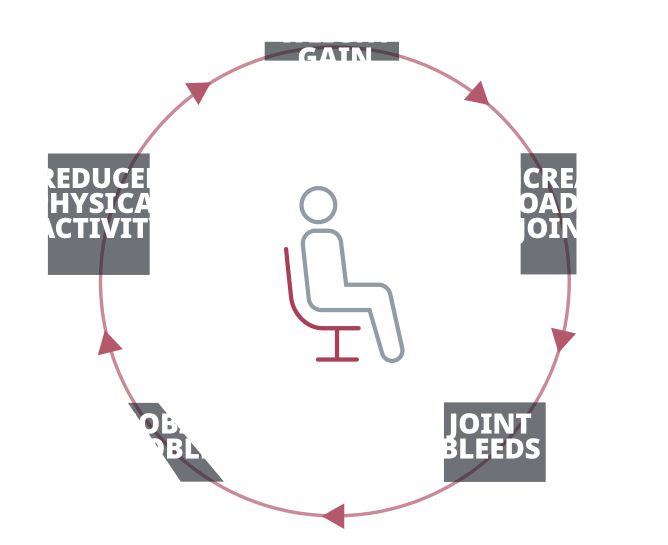
PATIENTS CAN BECOME TRAPPED IN A VICIOUS CYCLE OF PHYSICAL INACTIVITY8
Reduced physical activity can lead to weight gain, which may then lead to an increased load on joints. That load can then be followed by further bleeds and mobility problems.8
Luke lives with hemophilia A.
References:
- Wheeler AP, Amos LE, Gupta S, et al. Treatment of haemophilia A without inhibitors: real-world treatment patterns and clinical outcomes in the US. Haemophilia. 2026;0:1-12.
- Srivastava A, Santagostino E, Dougall A, et al. WFH Guidelines for the Management of Hemophilia, 3rd edition [published correction appears in Haemophilia. 2021;27(4):699]. Haemophilia. 2020;26(suppl 6):1-158.
- Ząbczyk M, Natorska J, Undas A. Novel factors affecting fibrin clot formation and their clinical implications. Polish Archives of Internal Medicine. Published online November 6, 2024.
- Mihalko E, Brown AC. Clot structure and implications for bleeding and thrombosis. Semin Thromb Hemost. 2020;46(1):96-104.
- Sidonio RF Jr, Hoffman M, Kenet G, Dargaud Y. Thrombin generation and implications for hemophilia therapies: a narrative review. Res Pract Thromb Haemost. 2022;7(1):100018.
- Verhagen MJA, van Balen EC, Blijlevens NMA, et al. Patients with moderate hemophilia A and B with a severe bleeding phenotype have an increased burden of disease. J Thromb Haemost. 2024;22(1):152-162.
- Yuste VJ, Percier C, Prashanth S, et al. Real-world unmet treatment needs for patients with haemophilia: results from the Global Adelphi Disease Specific Programme Database. Haemophilia. 2026. Online ahead of print. doi:10.1111/hae.70313
- Matlary RED, Grinda N, Sayers F, Vershoot O, McLaughlin P; EAHAD Physiotherapists Committee. Promoting physical activity for people with haemophilia in the age of new treatments. Haemophilia. 2022;28(6):885-890.

