


IDENTIFY BARRIERS
for more effective shared decision-making in hemophilia A1,2


Nikola lives with hemophilia A.
ARE PATIENTS REPORTING
ALL BLEEDS?
In a real-world, 2-year study of 354 patients with hemophilia A1
Patients reported more bleeds in a survey than were recorded in their medical records1

This discrepancy may mean patients are not reporting all bleeds, warranting the need for deeper discussions1,2

Data from an observational study including 354 patients with hemophilia A, conducted from 2020 to 2022, were collected through online surveys as part of the PicnicHealth research platform. The bleed events included data from medical records as well as patient-reported data from the survey. Results from this study may be limited by medical record discrepancies, recall bias, and potential reporting bias for bleeds.1

Bentlee lives with hemophilia A (with mom Teilei).
People with SEVERE hemophilia A had anxiety about breakthrough bleeds1,3
In a real-world observational study of 354 patients with hemophilia A1,3
33%
(N=75)
AND
47%
(N=83)
ON FVIII MIMETIC AND FVIII PROPHYLAXIS, RESPECTIVELY, reported feeling anxious ABOUT BLEED PROTECTION, AT LEAST SOMETIMES1,3
Response to survey question: “Because of taking your current treatment, how often do you feel anxious that your current treatment might not be adequately protecting you from bleeding?” Response options were: never, rarely, sometimes, often, and always.1
Survey responses were collected in a cross-sectional study design. Responses in individuals over time may vary and may not account for continuous patient participation.

Nikola lives with hemophilia A.

Healthcare providers may refer to individual product labels for product-specific efficacy and other information. Data are descriptive, not head-to-head.
Data from an observational study including 354 patients with hemophilia A, conducted from 2022 to 2023, were collected through online surveys as part of the PicnicHealth research platform. Patients responded to supplemental questions assessing anxiety about bleed protection using a 5-point scale: never, rarely, sometimes, often, or always. Limitations may include selection bias due to the cross-sectional study design and variability in individual responses over time and does not account for continuous patient participation.
DO PATIENTS FEEL LIMITED IN THEIR DAILY LIVES?
In an analysis of secondary data from a real-world study of 431 adults with hemophilia A1
Patients on FVIII mimetic (N=43) reported a
29%
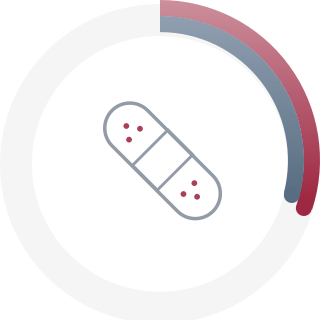
Patients on FVIII prophylaxis (n=210) reported a
30%
loss of ability to do daily activities
Response to survey question: “During the past seven days, how much did your hemophilia affect your ability to do your regular activities, other than your paid job?” Patients responded on a scale of 0 to 10, where 0 is “Hemophilia had no effect on my daily activities” and 10 is “Hemophilia completely prevented me from doing my daily activities.”
Healthcare providers may refer to individual product labels for product-specific efficacy and other information. Data are descriptive, not head-to-head.
Analysis of secondary data collected as part of a repeated cross-sectional, retrospective observational study of 431 adult patients with hemophilia A in the United States. Data collected as part of the CHESS US data platform were used from 2019, 2023, and 2024. Information was collected using two questionnaire forms: a web-based ‘case record form’ (CRF), completed by physicians, and a ‘patient and public involvement element’ (PPIE) completed by patients. Limitations included the retrospective, non-interventional design and voluntary participation, which may introduce selection and recall bias.

Breakthrough bleeds and administration challenges have consequences
Giving up on any activity or interference with activities is a profound compromise patients could be making with current prophylaxis.
Patients with hemophilia A and B
may experience emotional and psychosocial burden4
According to a systematic literature review and meta-analysis of 28 studies, people with hemophilia A and B had an increased risk of4,c:
2.64x
Depression
1.74x
Anxiety
2.60x
Depression &
anxiety
CHALLENGES WITH CURRENT TREATMENT REGIMENS WERE ASSOCIATED WITH INCREASED RISK OF FEELINGS OF distress, worry, frustration, and anger5-7
cMeta-analysis was used to determine the prevalence of anxiety and depression in people with hemophilia (PWH). Pooled odds ratios for depression diagnosis, anxiety, and anxiety/depression were determined. Comparisons were between PWH and controls. Depending on the availability of control data in a given study, two types of control populations were used to calculate odds ratios (OR). If the study included a control population, then this was used to determine OR. However, if the study did not collect data on control subjects, then available data from the US general population, matched by study year, were used. Meta-analysis included 9 studies (depression), 13 studies (anxiety), and 6 studies (anxiety and depression combined) to calculate the risk of depression, anxiety, or anxiety/depression in PWH.4
Luke lives with hemophilia A.
Key questions to ask your patients
- Do you feel confident that your regimen can fit into your lifestyle? Why or why not?
- Are you concerned or are your patients concerned with high-volume doses with an every-4-week regimen or vein health due to frequent infusions?
- Is bleed protection a concern for you with the current dosing schedule?
- What information will you need to feel more confident about a less frequent dosing schedule?
Lack of patient confidence in treatment outcomes may act as a barrier when it comes to shared decision-making.
CAN DEEPER CONVERSATIONS HELP UNCOVER TRADE-OFFS?
Fostering in-depth discussions with your patients may help uncover physical or emotional burdens.8
Some QUESTIONS TO REVEAL UNSPOKEN COMPROMISES
FVIII MIMETIC

How would you describe your level of confidence around bleed protection with less frequent dosing?
What administration challenges have you experienced, if any?
What factors do you consider when thinking about your preferred dosing interval (ie, every-4-week dosing)?
How does the time it takes to prepare and inject treatment impact you?
Do you have concerns about breakthrough bleeds?
What might prevent you from adopting a less frequent dosing interval (eg, every 4 weeks)?
If you have difficulty taking your medicine as prescribed, why might that be?
FVIII PROPHYLAXIS
What is your level of confidence around bleed protection with SHL or EHL prophylaxis?
How concerned are you with venous access due to frequent infusions?
What role does infusion frequency play in your decisions to start, continue, or stop treatment?
How does the time it takes to prepare and infuse treatment impact you?
Does having to take your medicine as prescribed have an impact on you and your lifestyle?
What factors would lead you to consider a change in therapy?
Are administration challenges with your current therapy holding you back?8
BRING THEIR TRUTH
TO LIGHT
Consider patient trade-offs when addressing hemophilia A management

IDENTIFY UNEXPRESSED PATIENT GOALS8

Explore what is working and not working with their current management approach to inform future decisions8

Luke lives with hemophilia A.
CHESS US=Cost of Severe Hemophilia across the US: a Socioeconomic Survey; EHL=extended half-life; FVIII=Factor VIII; SHL=standard half-life.
References:
- Data on file. Novo Nordisk Inc; Plainsboro, NJ.
- Srivastava A, Santagostino E, Dougall A, et al. WFH Guidelines for the Management of Hemophilia, 3rd edition [published correction appears in Haemophilia. 2021;27(4):699]. Haemophilia. 2020;26(suppl 6):1-158.
- Wheeler AP, Cibelli E, Hanson G, et al. Treatment and disease burden in a cohort of people with haemophilia without inhibitors in the United States. Haemophilia. 2025;31(5):912-921.
- Al-Huniti A, Reyes Hernandez M, Ten Eyck P, Staber JM. Mental health disorders in haemophilia: systematic literature review and meta-analysis. Haemophilia. 2020;26(3):431-442.
- Thornburg CD, Duncan NA. Treatment adherence in hemophilia. Patient Prefer Adherence. 2017;11:1677-1686.
- Brod M, Bushnell DM, Neergaard JS, et al. Understanding treatment burden in hemophilia: development and validation of the Hemophilia Treatment Experience Measure (Hemo-TEM). J Patient Rep Outcomes. 2023;7(1):17.
- duTreil S. Physical and psychosocial challenges in adult hemophilia patients with inhibitors. J Blood Med. 2014;5:115-122.
- World Federation of Hemophilia. WFH Shared Decision Making Tool: World Federation of Hemophilia. Last reviewed: August 2024. Accessed March 10, 2026. https://www1.wfh.org/publications/files/pdf-2371.pdf

